Myopia Clinic
AMARDEEP EYECARE offers a range of treatment options to slow the progression of myopia, protecting your child’s eye health in the future.
In your child’s yearly routine eye exam, the doctor will provide a detailed evaluation to see if your child is a candidate and what option to proceed with. A detailed evaluation will decide which of these options would minimize progression as much as possible.Before that you need to know a little about myopia and its importance in current scenario
WHAT IS EMMETROPISATION ?
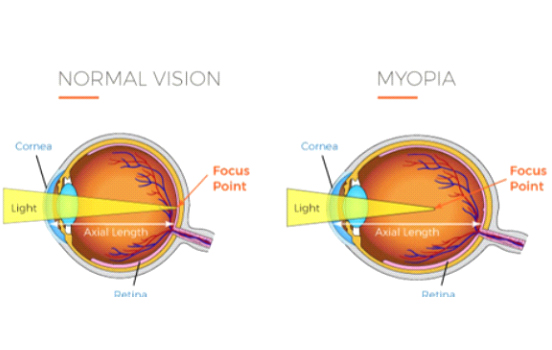
At birth the average axial length of the eyeball is 18mm, thus in new- born the eye is hypermetropic. (PLUS POWER) As the child grows eye elongates, this hypermetropia diminishes and as the development stabilises emmetropia (nil power) is reached. But in some cases the tendency of the eyeball to grow progress, and hence a lesser or greater degree of myopia is the result. Myopia may be said to develop only during the period of active growth
MYOPIA (NEARSIGHTEDNESS)
It is the most common ocular condition in children and young adults leading to blurred vision and increasing incident around the world, with many now calling it an epidemic.It is Caused by an increase in eye length (more common type¹) or overly curved cornea and/or lens. A person with myopia can see clearly objects close to the eye, but he/she will have difficulty seeing objects that are far from the eye.It usually develops and progresses in childhood, especially at school-going age
Unfortunately after covid 19 era we are practicing more indoor-centric lifestyle, relying mostly on digital ecosystem with involvement in intense near work activities and hence limited outdoor time. This results in an epidemic of myopia in India.
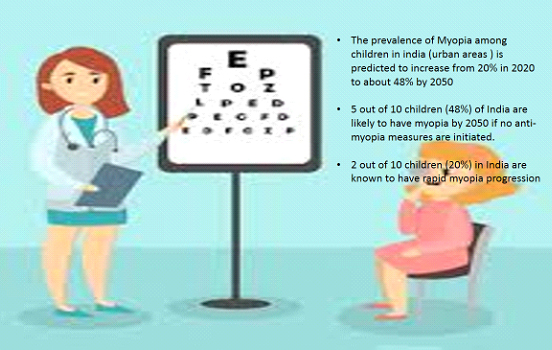
Hence it is a serious public health concern of the 21st century and is going to affect approximately half of the global population (5 billion) by 2050
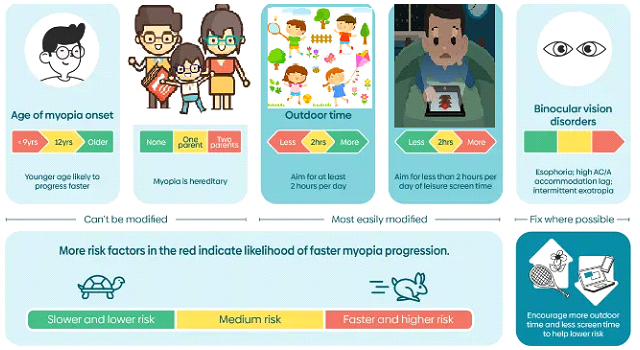
RISK FACTORS FOR DEVELOPING MYOPIA
Myopia typically develops around age 8 and progresses for 10-15 years
A young age when myopia was first diagnosed
A higher degree of myopia when first diagnosed
Recent eye growth Increased axial elongation precedes the onset of myopia
Myopic parents : having one or two myopic parents increases the risk
Time outdoors: less time outdoors increases the risk
Near work: reading at very close distances < 20 cm and for continuous periods of time > 45 min increases the risk
Reading in dim illumination
Low birth weight – <2kg & premature birth-<37 weeks increases the chance of myopia
Binocular vision :high accommodative lag and high AC/A ratio increases the risk 4.5
Under correction (wearing a spectacle of lower power than actually required)
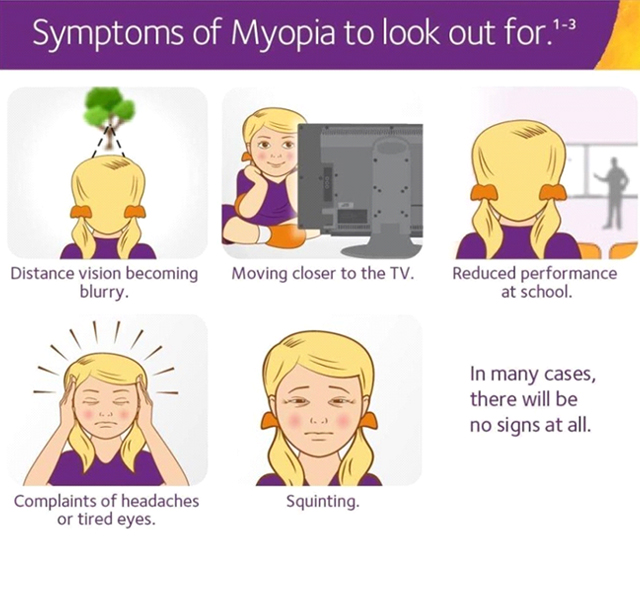
HOW WILL I KNOW IF MY CHILD IS HAVING MYOPIA?
Finding difficulty in seeing or copying from black board while sitting in last bench
Holding books, mobiles too close,or sitting close to watch television.
Faces difficulty to see while driving.
Squinting while looking at distant objects.
Squeezing the eyes to see the object, complaining of headache or blurred vision
HOW CAN WE PREVENT MYOPIA AND ITS PROGRESSION ?
Annual eye examination for your children.
First time wearer of myopic spectacles:
Every child for the first time wearing myopic spectacles requires a detailed risk assessment of myopia.
Frequent change in spectacle power:
Frequent change in spectacle is a significant sign of myopia progression and an increase in the axial length
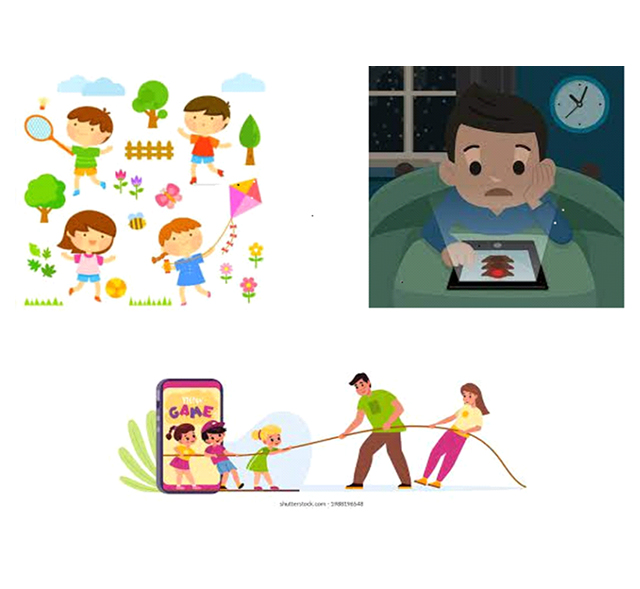
Avoid continuous near work.
Spend at least 60-90 minutes in natural light (sunlight).
Avoid reading/watching screen in dim illumination.
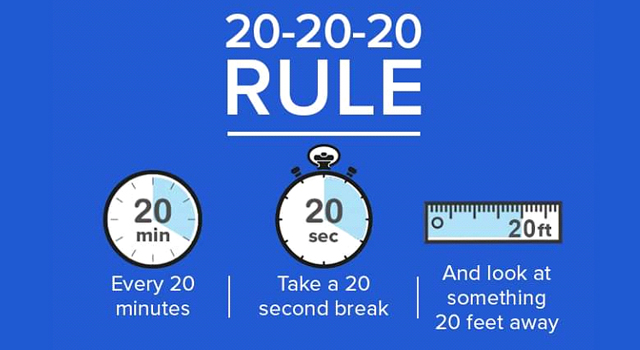
Take regular breaks while doing near activities
WHY WE NEED TO BE VIGILANT ABOUT MYOPIC PROGRESSION?
Myopia increase the chance of blinding conditions such as retinal detachment, cataracts, glaucoma and myopic retinal degeneration later in life. The risk of these conditions is much higher as the degree of myopia increases.
MYOPIA MANAGEMENT STRATEGIES
Involves all aspects of eye and vision care for myopic patients, including myopia risk assessment, prevention, early detection, proper correction, timely control, and management of related complications.
EXISTING SOLUTION TO REDUCE MYOPIA PROGRESSION
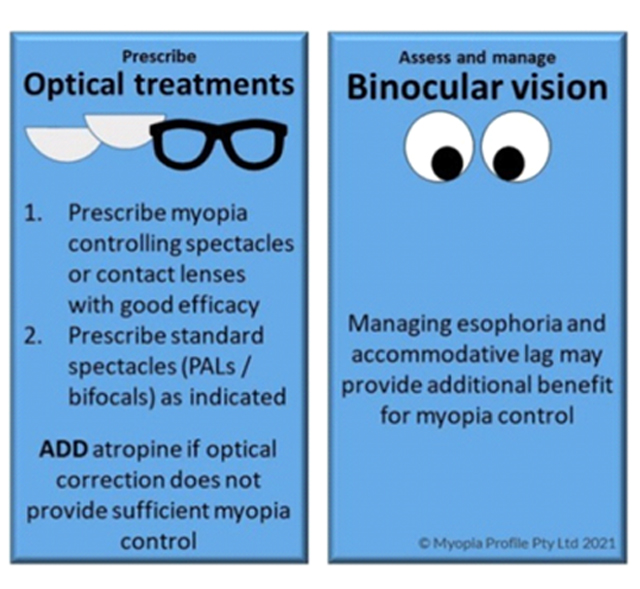
With current evidence-based treatments available that have shown efficacy in slowing down the progression of myopia, we use environmental, optical and pharmacological myopia control strategies in our myopia centre. Our myopia care team would thoroughly evaluate your child before discussing and advising you on the most appropriate treatment option.
Other Considerations
Practice Your Child The 20-20-20 Rule
Low Dose Atropine
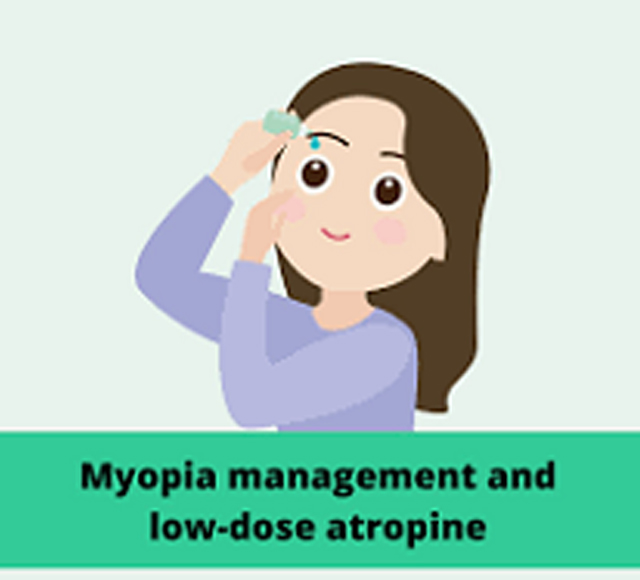
Studies over the last decade have found that much lower concentrations of atropine, such as 0.02%, 0.01% have a comparable reduction in myopia progression, without any noticeable effect on pupil size or near-focusing. It was initially thought that as atropine drops paralysed the focusing muscles of the eye, this was the reason for the myopia control. Now suggests that the atropine molecule affects a receptor in the RETINA (muscarinic receptors), signalling the eye to stop growing excessively
Atropine drops need to be instilled at night and can be combined with ORTHOK therapy to theoretically maximise the myopia control effect.
CONTACT LENSES ORTHOKERATOLOGY (ORTHO-k) LENSES
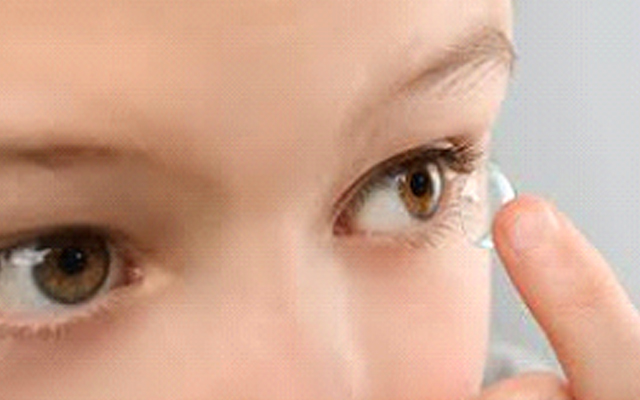
These are contact lenses, when worn during sleep, gently reshape the cornea to correct vision. This temporary reshaping provides clear vision all day, which eliminates the need for glasses or contact lenses. This treatment corrects vision in a way that has been shown to slow the progression of myopia by about 50%.
HOW DOES ORTHOK VISION CORRECTION SLOW MYOPIA ?
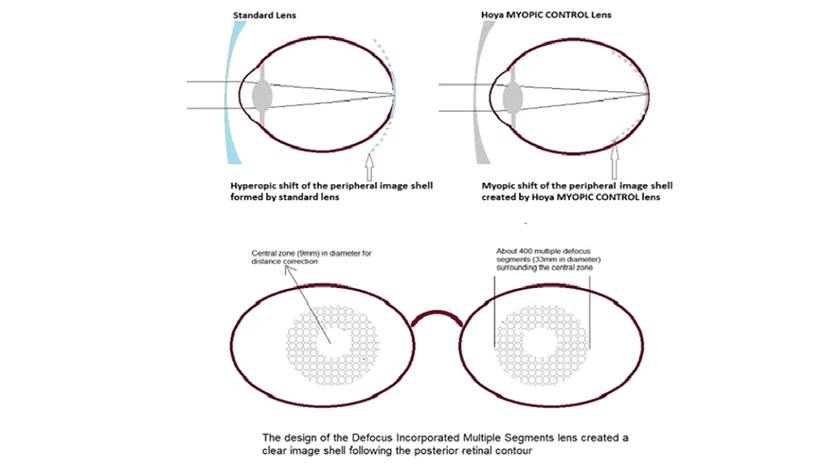
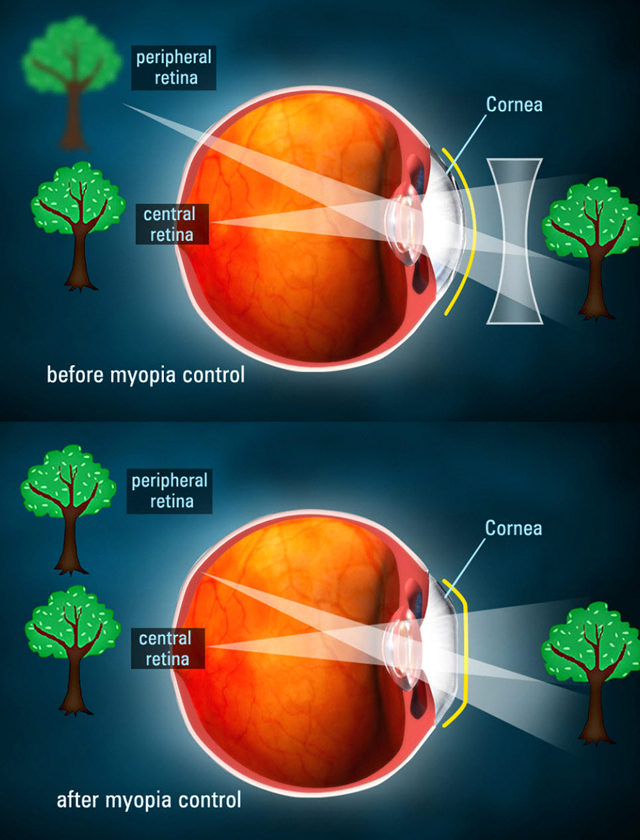
When myopic eyes are corrected with conventional spectacles and contact lenses, light entering the eye centrally will focus at the retina; however, light entering off centre will focus behind the retina. This is thought to stimulate lengthening at the back of the eye as the retina tries to reach the focal point behind the eye, worsening the condition.
OrthoK lenses can slow this growth by changing the shape of the eye surface, allowing central light to focus accurately at the retina and off-centre light to focus in front of the retina. The retina will no longer ‘attempt’ to elongate (see image).
SOFT CONTACT LENSES
A range of modern multifocal soft contact lenses that are more appropriate for children and teenagers at risk of progressive myopia.
Soft multifocal contact lenses is an excellent option to provide reasonable myopia control effect, while giving improved vision during wear. They work to control myopia progression in a similar way to orthoK lenses; by changing the way off-axis light to focus on the back of the eye. The main difference from orthok lenses is that soft lenses are worn during the day rather than at night.
SOFT CONTACT LENSES
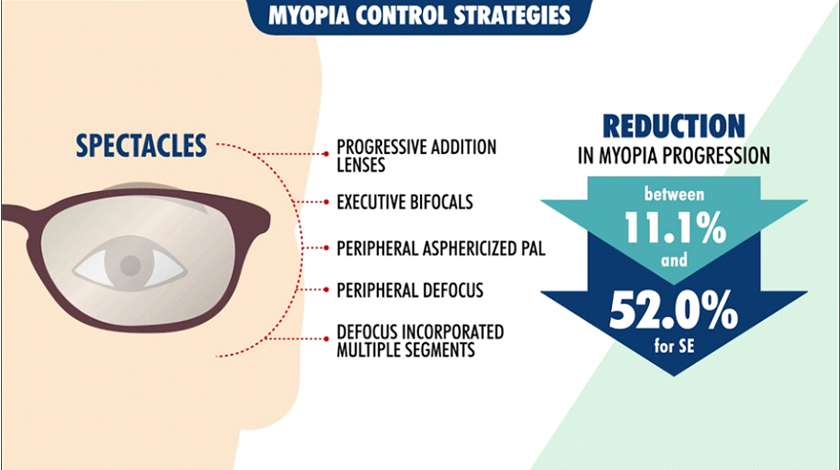
As mentioned previously, normal spectacles offer very little myopia control benefit. Lately however newer-generation myopia control spectacle lens designs have emerged, inspired by some of the optical benefits seen from orthokeratology and multifocal soft contact lenses.. These lens designs show myopia control prescription effects, and axial length control, more in line with existing myopia control strategies as mentioned above. As such they are a useful option to consider when deciding on which myopia control treatment to use, especially if the child is young or not suitable for contact lens based options or eyedrops, or wants to keep using spectacles.